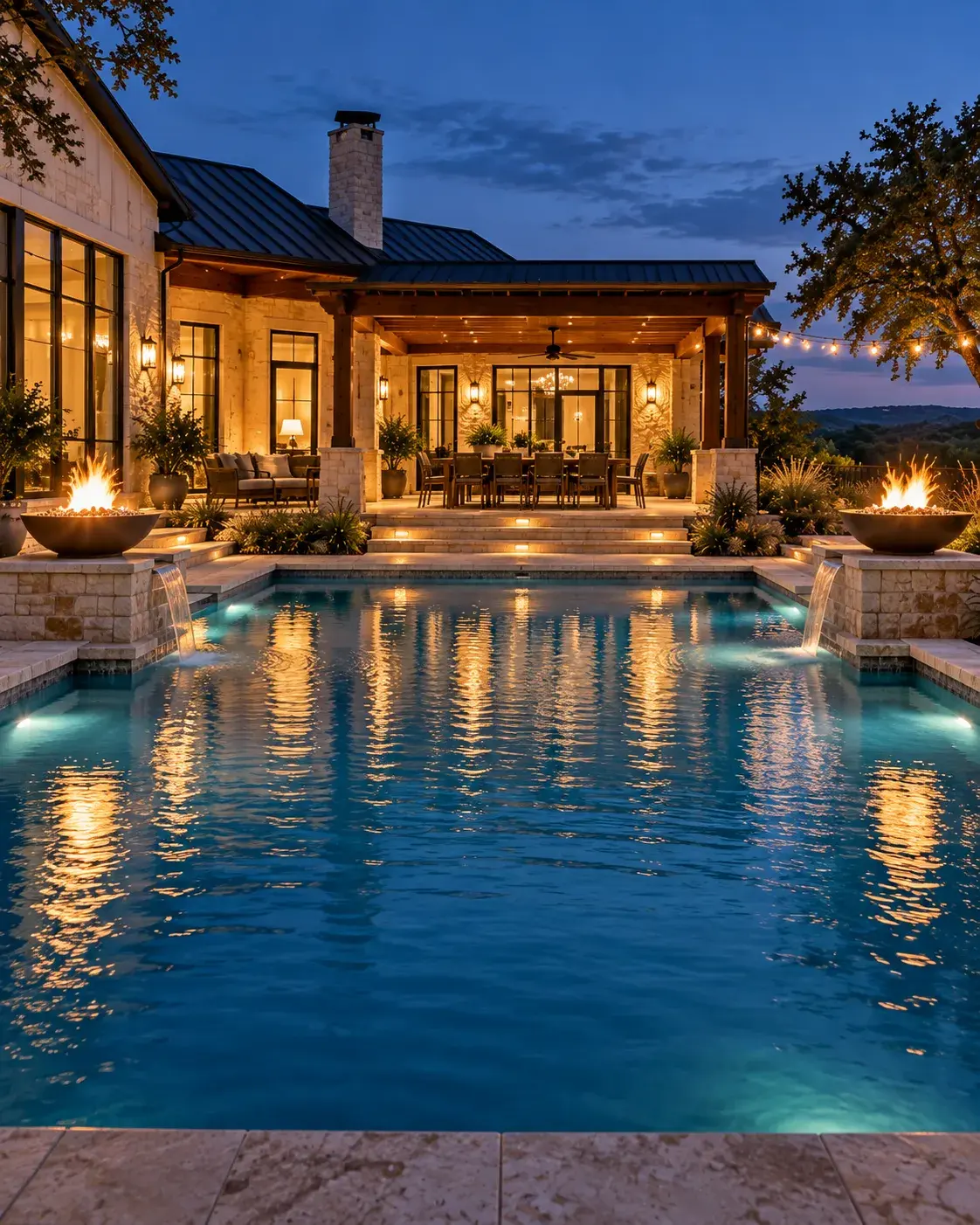
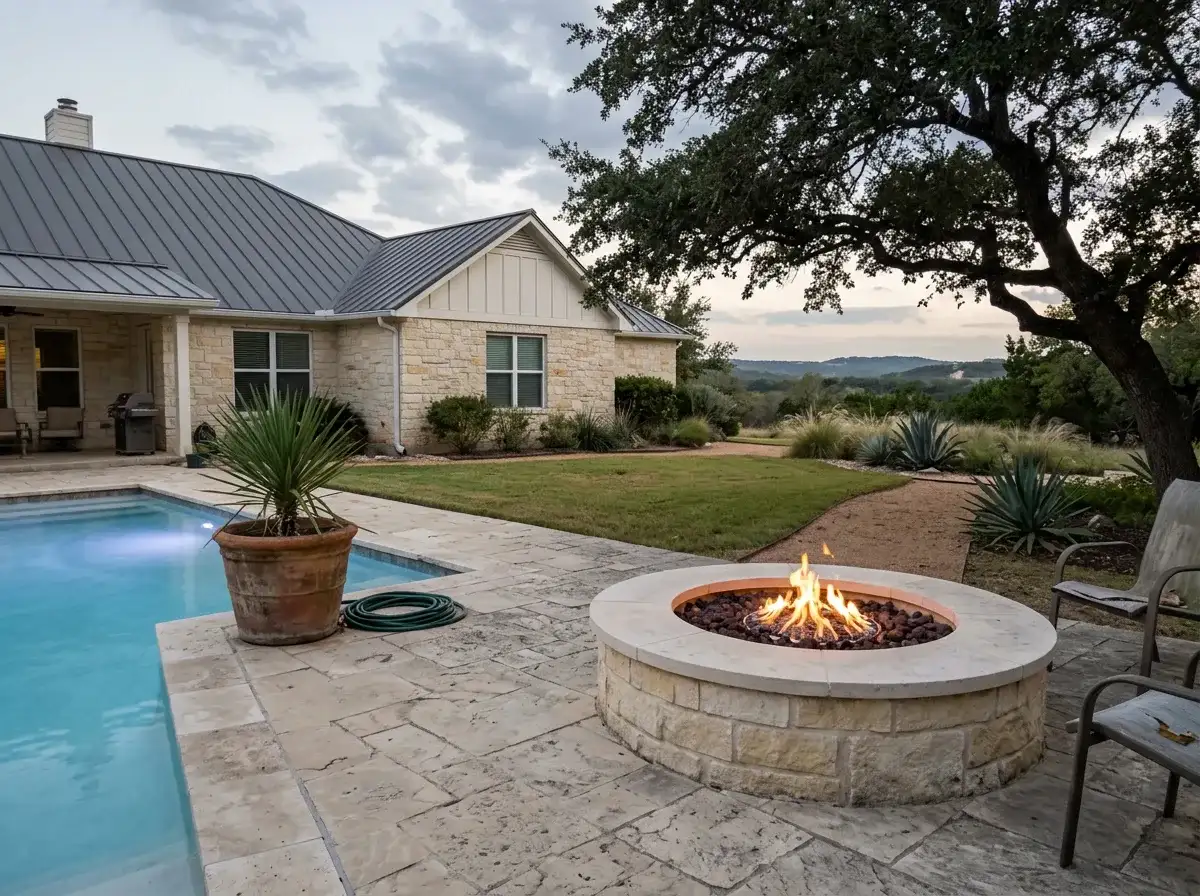
A gas fire pit is a burner fed by natural gas or propane and set in a pit, table or fireplace, with no firewood to burn. Homeowners ask whether a gas fire pit is considered an open fire because the answer decides where it can sit, when it can run and who has to sign off. The short version comes first, then the rules behind it.
Is a gas fire pit considered an open fire?
Usually not in plain terms, but no Austin or Travis County page we reviewed says gas pits are exempt. Austin Fire's page covers solid-fuel recreational fires and portable outdoor fireplaces and does not mention gas units. A burn ban order can still cover open flame, so read the current order and your unit's manual before you rely on gas.
Many online guides say gas is generally allowed during a ban. That is common practice, not county text. Treat it as a reasonable expectation that you confirm, not a guarantee.
How does Austin define open burning and a recreational fire?
Austin Fire says open burning is strictly prohibited inside the city. A recreational fire is the allowed exception: a solid-fuel fire that is not in an outdoor fireplace, grill or pit, no more than 3 feet across and 2 feet high. It must sit at least 25 feet from structures and combustibles, and a portable outdoor fireplace must sit 15 feet away, per Austin Fire's recreational fire page. Source
A gas pit or fire table is open on top, and the Austin Fire page does not name it. That gap is why we tell homeowners to read the manual and call the fire department.
Is a propane fire pit considered an open fire too?
Propane gets the same treatment as natural gas in the rules we reviewed, which means neither is named. The difference is the fuel supply. A tank needs a safe spot, easy shutoff access and a stable base, and Austin's local fire code amendments call for an operational permit for liquefied petroleum gas. We could not confirm whether that reaches small residential tanks, so ask before you assume.
| Fire type | Austin Fire treatment | In a burn ban | Distance to follow |
|---|---|---|---|
| Wood recreational fire | Allowed within size limits and attended | Restricted, since Travis County says bans cover all outdoor burning | 25 feet from structures and combustibles |
| Portable outdoor fireplace | Covered by Austin Fire guidance | Treat as restricted unless the order says otherwise | 15 feet |
| Natural gas fire pit | Not addressed on the recreational fire page | Order wording governs; confirm with the Fire Marshal | Manufacturer's listed clearances; ask Austin Fire |
| Propane fire pit | Not addressed; tank rules may apply | Same as natural gas | Manufacturer's clearances plus tank placement in the manual |
| Gas fire table | Not addressed | Same as natural gas | Manufacturer's listed clearances |
| Outdoor fireplace with a chimney | Outside the recreational fire definition on Austin Fire's page | Order wording governs; burning wood is the larger risk | Built to code, with permits where required |
The gas rows are our reading of the code's silence, not a quote from it. The manual and the fire department fill that gap.
Can you use a gas fire pit during a burn ban in Travis County?
Maybe, and the order's wording decides. Travis County says burn bans restrict all outdoor burning, and its Fire Marshal FAQ allows open flame cooking only when the flames are completely enclosed in the cooking device. The county's burn ban is issued for the unincorporated areas of Travis County, so inside Austin city limits the Austin Fire Department is the one to ask how a ban affects a gas unit. The county pages do not mention gas fire pits either way.
Ban status changes often, so we won't print today's status here. Check the county burn ban page, sign up for its text alerts and call the Fire Marshal if the order is unclear. Hays and Williamson counties set their own bans, so a Buda or Georgetown address follows a different order.
Which fire rules apply if you live outside Austin city limits?
The rules follow your address. Outside the city, the Travis County Fire Marshal and your local Emergency Services District (ESD) apply, and the county adopted the 2021 Fire Code effective January 1, 2026. Cities such as Lakeway and Dripping Springs, plus Hays and Williamson counties, can add their own rules. Source
ESDs write their own guidelines. Pflugerville ESD 2, for example, permits outdoor fires at single-family homes only when contained in a manufactured portable pit, a permanent non-combustible pit, an outside fireplace or a chiminea. We have not checked every rule in Bee Cave, West Lake Hills or the other Hill Country towns. Call your fire authority and read your HOA covenants before you design.
How far should a gas fire pit be from the house?
Austin's written distances are 25 feet for a recreational wood fire and 15 feet for a portable outdoor fireplace. Gas units are not named, so follow the clearances printed in the manufacturer's manual and confirm them with Austin Fire. Never place a burner closer than the manual allows, even when the code text seems silent. Source
Measure from the point the manufacturer's manual names, which may be the burner or the outer edge of the unit. Each one is practice, not code:
- House walls, eaves and soffits, including anything that sticks out above the flame.
- Wood fences, sheds and stacked firewood.
- Live oak and cedar limbs overhead, plus the leaf litter under them.
- The property line and any neighbor's structure.
- The gas shutoff or tank valve, which you should reach without walking past the flame.
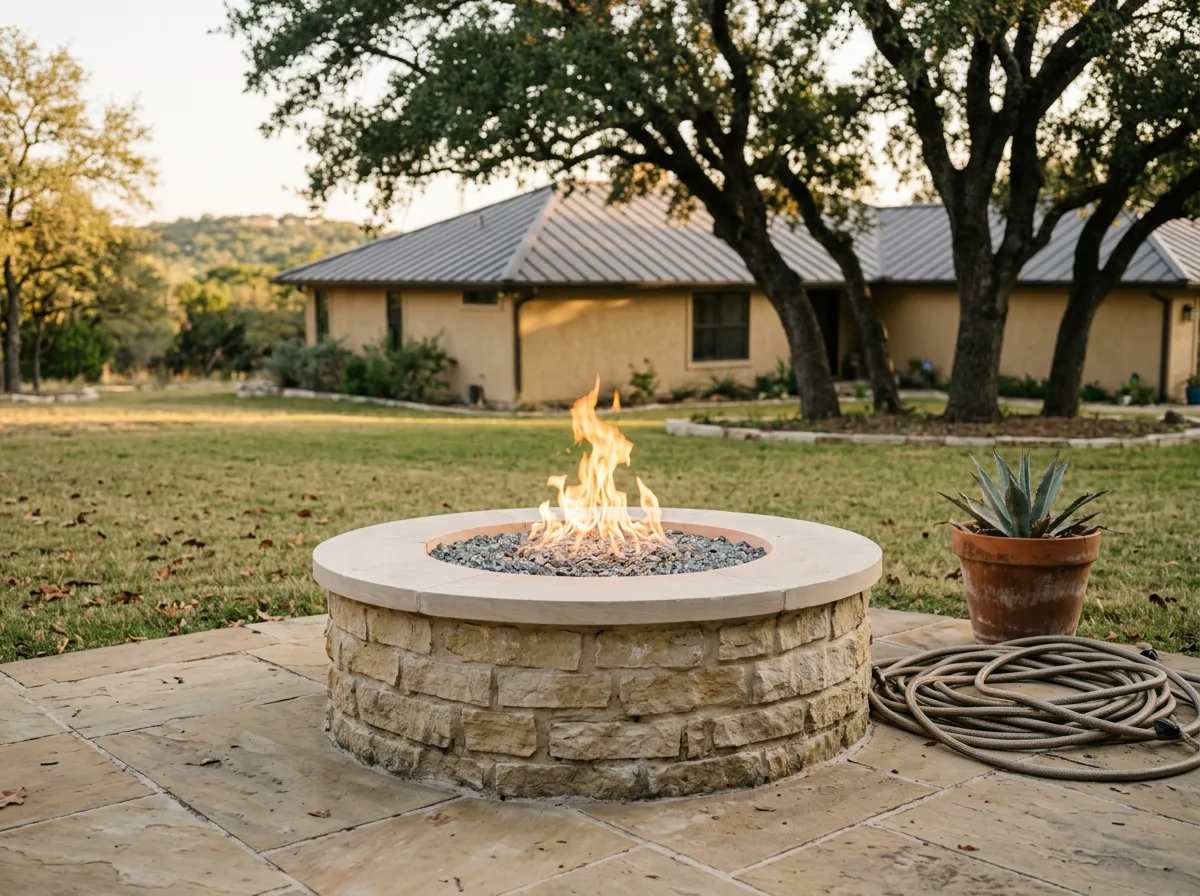
Can you put a gas fire pit under a pergola or on a covered patio?
Only if the unit's manual says so and the structure clears its overhead requirement. Most fire pits are designed for open air, and a covered patio can trap heat and combustion gases. Most good designs keep the fire in the open and the seating under the roof.
Overhead clearance in manuals varies with the unit's BTU rating and the material above it, so the manual controls. When a client wants fire and shade together, the usual answer is to separate them on the plan. The patio and pergola carry the shade, and the fire feature sits beside them in the open. The table below is practice, not code.
| Overhead material | Concern | Practical rule |
|---|---|---|
| Wood pergola | Radiant heat dries and chars slats over time | Keep to the manual's overhead clearance and choose a unit rated for covered use |
| Vinyl or composite | Can warp or discolor from heat | Follow the manual's warning and move the burner out from under it |
| Metal frame | Conducts and holds heat | Allow extra room so no one touches hot metal |
| Solid or closed louvered roof | Traps heat and gases | Do not run a pit under it unless the manual and a code official approve |
Can you put a gas fire pit near a pool, and how close?
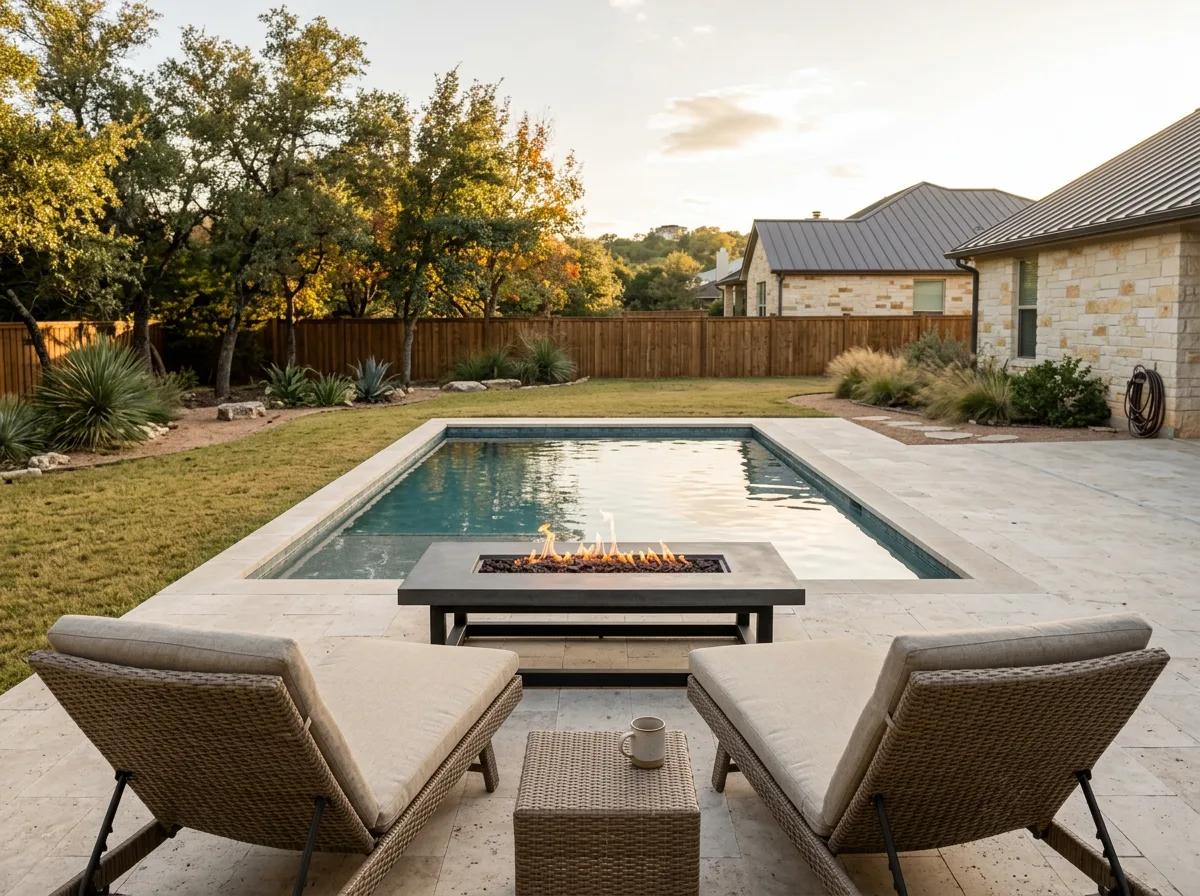
No official source we found gives a distance from a fire feature to a pool edge. It is a design call, not a code number. Plan around wind, splash and wet feet, and keep the burner's manual clearances for anything combustible nearby.
- Wind: place the burner where the usual breeze does not push heat and smoke across the seating or the water.
- Splash: keep the burner and controls out of the splash zone and away from where swimmers climb out wet.
- Surface: use a level, non-combustible base around the burner, and slip-resistant material on the paths that lead to it.
- Equipment: keep the pit away from pool equipment and gas shutoffs.
Westbank Pools lays out the fire feature in the 3D design of the pool and outdoor living space before contract. The burner, the pool edge and the seating get checked on screen first. Complete engineering and construction drawings come before work starts, so the gas run and the footing are planned around the shell instead of fixed afterward. Our pool installation process builds in that order.
Do you need a permit for a gas fire pit in Austin?
Plan on a plumbing permit for any natural gas or hard-piped propane line, and have a licensed plumber confirm it with Austin Development Services before work starts. A freestanding unit on a portable tank is a different case, and a built-in masonry structure can raise building questions, so ask Austin Development Services first.
Tell your insurer about a new gas feature, and check HOA review rules before you order materials.
Is a gas fire pit the better choice in dry Hill Country weather?
Often yes. A gas flame throws no sparks or embers, so there is less to manage on a dry, windy night. It is not risk free, because radiant heat, a tipped portable unit and dry leaves still matter.
Grass killed back by a winter freeze becomes easy fuel when the weather turns dry, warm and windy, and a Hill Country yard can dry out fast in summer. Keep the ground around the burner clear of leaves and cedar litter, and never leave a lit unit unattended.
Site conditions matter as much as fuel. In our experience, shallow limestone makes footings and gas trenching harder west of MoPac, and expansive clay east of I-35 can move a slab and crack a surround. We cover both in our posts on how Austin soil affects pool construction and building on a sloped backyard. A burner needs a level, non-combustible base, and a slope often calls for a terrace or retaining wall first.
Gas fire pit vs fire table vs outdoor fireplace: which fits your yard?
Choose a fire pit for gathering around the flame, a fire table when you want the flame at dining or lounge height, and an outdoor fireplace for a vertical focal point that can shelter the fire. Gas can power all three. The right pick depends on your layout, your wind and your jurisdiction.
| Feature | Best fit | Placement notes | Rules to check |
|---|---|---|---|
| Gas fire pit | Open patios where people circle the flame | Open air, level non-combustible base, manual clearances | Burn ban order and the manual |
| Gas fire table | Smaller patios, dining and lounge height | Check the manual's overhead clearance if it sits near a pergola | Burn ban order and the manual |
| Outdoor fireplace | Covered or semi-enclosed patios, a vertical focal point | Needs a footing and a chimney or stack; can burn wood or gas | Permits, plus the burn ban order if you burn wood |
Our fireplaces and fire pits page shows how each sits in a finished yard. Our post on fire features to complement your pool area covers how to pair them with the water.
What should you check before you build?
Confirm your jurisdiction, the current burn ban order and the unit's manual before you pour a footing. We are not the authority having jurisdiction, so the Austin Fire Department, your county Fire Marshal and the manufacturer have the final word.
- Find which fire authority covers your address: the city, the county Fire Marshal or an ESD.
- Read the current burn ban order for your county.
- Read the manual for clearances, overhead limits and tank rules.
- Hire a licensed plumber and have the gas permit pulled.
- Check your HOA covenants and tell your insurer.
- Keep an extinguisher or charged hose near the pit.