How much does an outdoor kitchen cost in Austin?
Published Austin builder guides put outdoor kitchen cost at about $8,000 to $150,000 or more, with most projects between $20,000 and $60,000. Those are published builder-guide figures, not a Westbank quote. Within that range, the price depends on four things more than any other: the appliances you choose, how far gas, power and water must travel, whether the dig hits rock or clay, and how much shade you add. A grill island sits at the low end, a sink-and-refrigerator L-shape in the middle, and a covered multi-station build at the top. A firm number needs a site visit. Source
Published Austin ranges disagree by a wide margin, and part of the reason is what they count. Some include only the island, counters and labor, and leave out appliances, shade and trenching. A written bid after a walk of your yard gives the real kitchen number, and a pool, if you are adding one, brings its own budget on top.
What do a basic grill island, a mid-range kitchen and a luxury kitchen include?
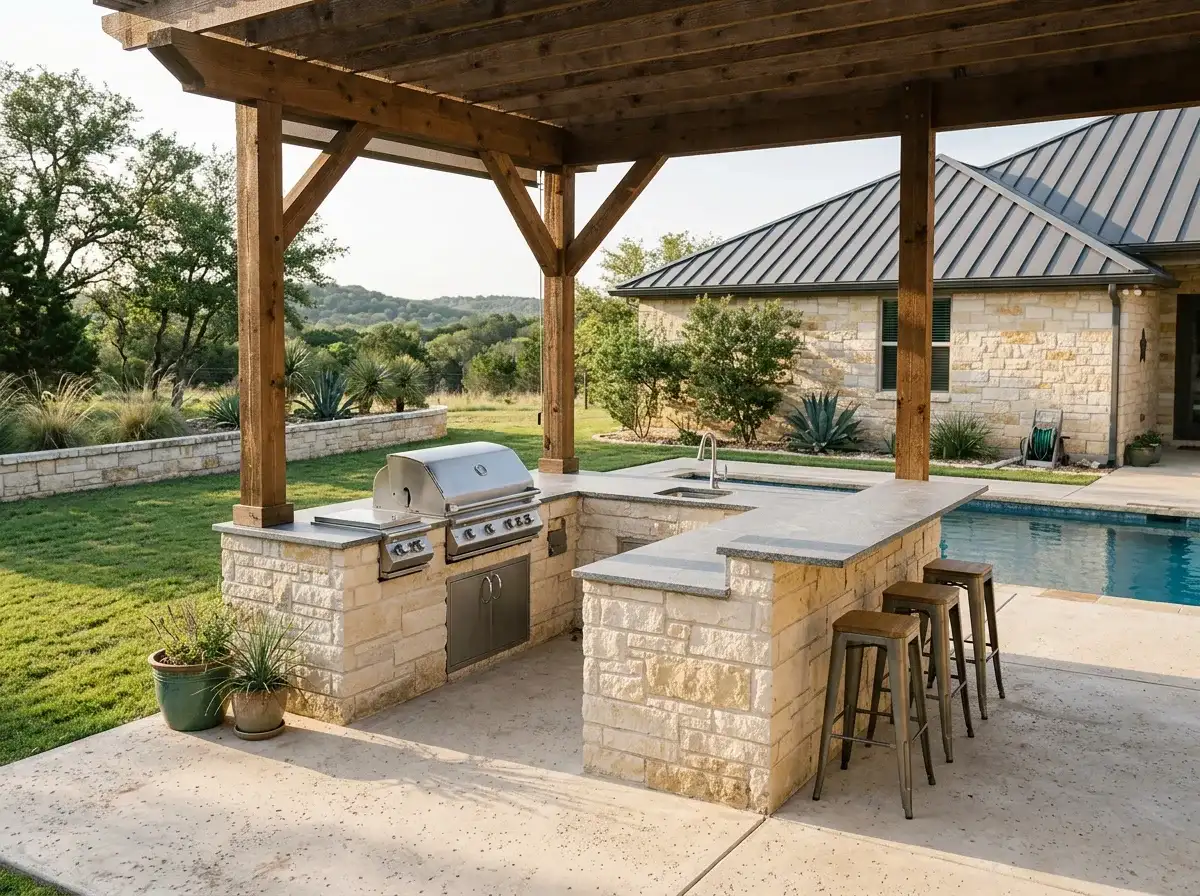
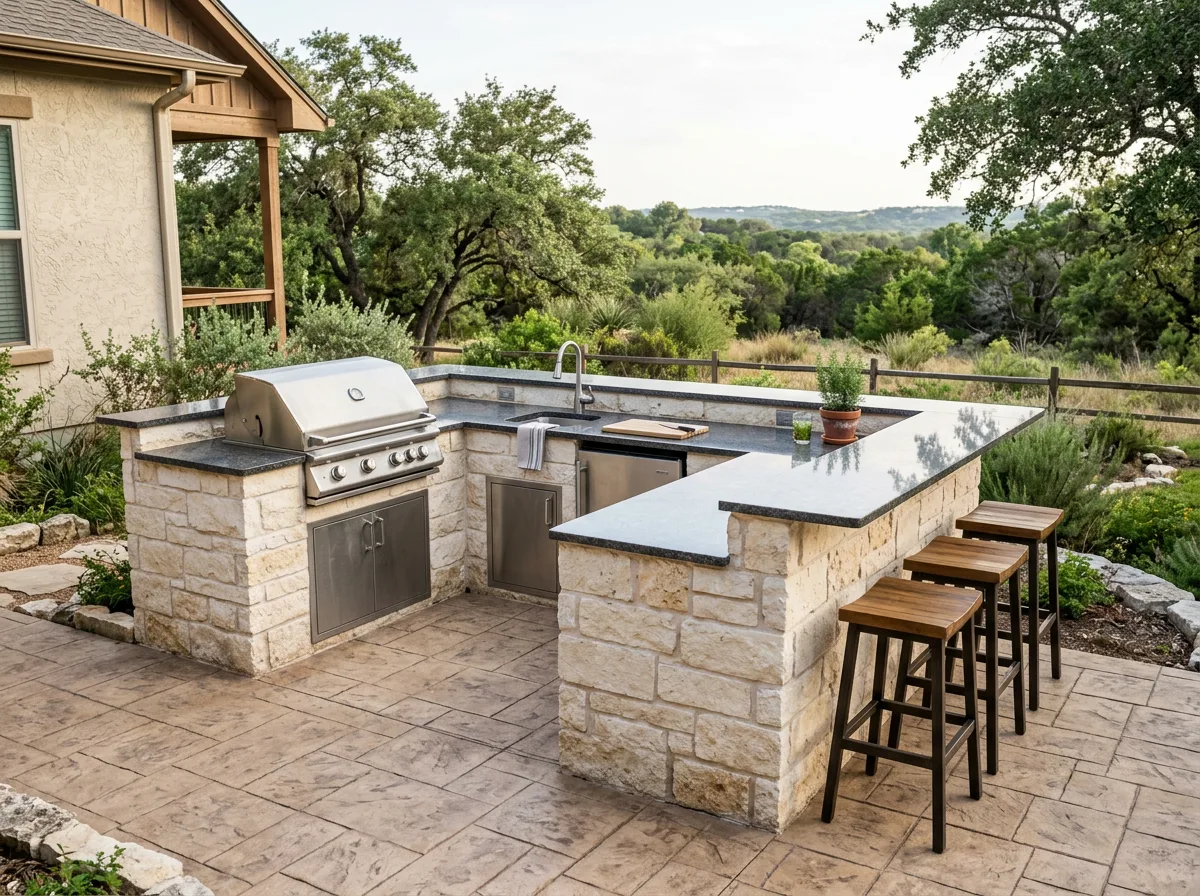
A basic grill island is a built-in grill with a short counter and storage. A mid-range kitchen is usually an L-shape with a sink, refrigerator and bar seating. A luxury kitchen adds several cooking stations, ventilation, lighting, a cover and often a television or fire feature. Each step up adds utilities, not only nicer finishes.
| Tier | What you get | Utilities it needs | What pushes it up | Published Austin range |
|---|---|---|---|---|
| Basic grill island | Built-in grill, short counter, closed storage, simple stone or stucco facing | Gas or propane, one GFCI outlet, usually no sink | Grill brand, facing material, distance to the gas source | About $8,000 to $15,000 |
| Mid-range L-shape | Grill, sink, under-counter refrigerator, longer counter, bar seating | Gas, power, water supply and drain | Appliance count, trench length, countertop material, partial cover | About $18,000 to $35,000 |
| Full luxury kitchen | Multiple stations such as griddle, smoker or pizza oven, vent hood, lighting, screens | Larger gas load, several circuits, water, drain, sometimes data | Appliance level, rock or clay site work, full roof or pergola, HOA and permit review | $40,000 and up |
The ranges in this table are published Austin builder-guide figures, not Westbank quotes. Source
Do most outdoor kitchens with grill and counter need a sink?
Most do not. A grill, a counter on each side and a closed cabinet cover everyday cooking. A sink adds a water line and a drain, and those two runs are where the budget grows fastest after the grill itself. Add a sink only if you will use it every week, and skip it if the kitchen is a long way from the house.
Here is our advice for first builds: skip the pizza oven, the smoker and the oversized refrigerator until you know how you cook outside. Instead, build the island so it can be extended, and have the crew stub gas, power and a capped conduit for later. Adding a station to a planned island usually costs less than tearing into finished stone and decking.
Is there an outdoor kitchen cost calculator that works in Austin?
A generic online calculator misses the Austin variables, so build your own worksheet. List seven lines: structure and labor, countertop, appliances, utility runs, site prep, shade and permits. Rate each as a small, medium or large swing for your yard, then ask every bidder to price each line in writing.
| Cost line | Typical swing on the total | What sets it in Austin |
|---|---|---|
| Structure and labor | Large | Island size, facing material, footing type, crew hours |
| Appliances | Large | Grill level, refrigeration, specialty stations, vent hood |
| Utility runs | Medium to large | Distance to meter and panel, trench through rock, slab or roots |
| Site prep | Small to large | Limestone west of MoPac, expansive clay east of I-35, slope |
| Countertop | Medium | Granite, concrete or porcelain, slab size, edge and cutouts |
| Shade or cover | Medium to large | Pergola or solid roof, west-sun exposure, HOA review |
| Permits and review | Small | Gas permit, cover review, tree rules, HOA submission |
Why is outdoor kitchen cost per linear foot a shaky number?
A per-foot price hides what sits inside the foot. Ten feet of plain block with a slab top and ten feet holding a griddle, a refrigerator and a sink are very different jobs. Use outdoor kitchen cost per linear foot only to compare bids that list the same appliances, utilities and finishes.
Many quoted averages cover only the island, countertops and labor, and leave appliances for a separate line. When two bids look far apart, ask three questions. Are appliances included and named by model? Who pays for the trench, and how far does it run? Is shade priced in or left out? The answers usually explain the gap better than a per-foot figure.
Granite or concrete: which outdoor kitchen countertop holds up in Austin heat?
Granite resists heat and, when sealed, most stains, and it needs little upkeep. Concrete can be poured to any shape and color, but it needs periodic resealing and can develop hairline cracks. Price moves with slab size, edge profile and cutouts, so ask each bidder to price both materials on the same layout before you decide.
Texas summers are hot enough that dark stone in direct sun can be too hot to touch. Lighter colors and a shaded counter solve that better than any sealer. East of I-35, where Blackland clay moves, a poured concrete top on a shifting base is also more likely to crack. Porcelain is a third option worth pricing if you want a thin, low-maintenance surface.
What makes gas, electric and plumbing runs cost more?
Utilities add more when the kitchen sits far from the house, the gas meter or the panel, and when the trench crosses rock, a slab or tree roots. Gas is a permitted job, and a sink adds both a supply line and a drain. Every extra foot of trench adds labor and inspection time. Published Austin figures put a gas line at about $500 to $3,000, electrical at about $800 to $3,000, and far water and drain runs at about $1,500 to $4,500. Source
- Gas: natural gas needs a line from the house or meter, while propane needs a tank location. The City of Austin states that no gas work is exempt from a permit.
- Propane: Austin Fire does not require a permit for non-commercial use at a single-family home, but you must give location and exposure information, and those requests are processed within seven calendar days.
- Electric: outlets, lighting and a refrigerator need GFCI-protected circuits, and anything near a pool follows the adopted electrical code.
- Water and drain: ask for a shutoff and a drain-down valve. Winter Storm Uri in February 2021 froze unprotected outdoor lines across the region.
Does Hill Country limestone or Austin clay change the price?
Yes. West of MoPac and across the Hill Country, thin soil sits on limestone, so footings and trenches may need rock work. East of I-35, Blackland clay shrinks and swells, so the slab and base need more preparation. Both add cost, just in different places on the bid.
Texas A&M AgriLife Extension describes the Austin-area soils as thin over exposed limestone on the Edwards Plateau and as shrink-swell clay on the Blackland Prairies. For a Dripping Springs or Lakeway lot, expect the crew to probe for rock before pricing the trench. For Round Rock or Pflugerville, expect more attention to drainage and base. Our post on how Austin soil affects pool construction goes deeper, and the same ground rules apply to a kitchen. If you are building in Dripping Springs, see our page on custom pools in Dripping Springs, and ask about rock first. Source
Do you need a permit for an outdoor kitchen in Austin?
Part of it often does. The City of Austin exempts items such as concrete flatwork and cabinets or countertops, but gas work always needs a permit, and a roof over the kitchen usually brings its own review. Confirm with the City before you sign a bid, because exemptions may not apply to every lot.
- Exempt list: the City's work exempt from building permits page lists flatwork and finish work, but exempt work must still meet code.
- Gas: always permitted, as noted above.
- Trees: the City Arborist treats trees 19 inches or more in diameter as protected, so trenching near a mature live oak can change the route.
- Other places: Round Rock, Georgetown, Cedar Park, Lakeway and Dripping Springs have their own rules, and unincorporated Travis, Hays and Williamson land follows county rules.
- HOAs: many review built-ins and covers before construction, so budget the review time.
Rules change, so call the permit office for your own address. If your lot is in Lakeway, see our page on outdoor living in Lakeway for how we handle local review. Do not rely on a neighbor's experience in a different city.
Do you need a pergola or patio cover, and how does it change the budget?
A cover is one of the larger add-ons, and in Austin it is rarely optional. In published Austin guidance, a pergola or patio cover adds about $8,000 to $30,000. Late-afternoon west sun hits a kitchen just when people cook. A pergola gives filtered shade, a solid roof gives rain cover, and the choice changes both the budget and the permit path. Source
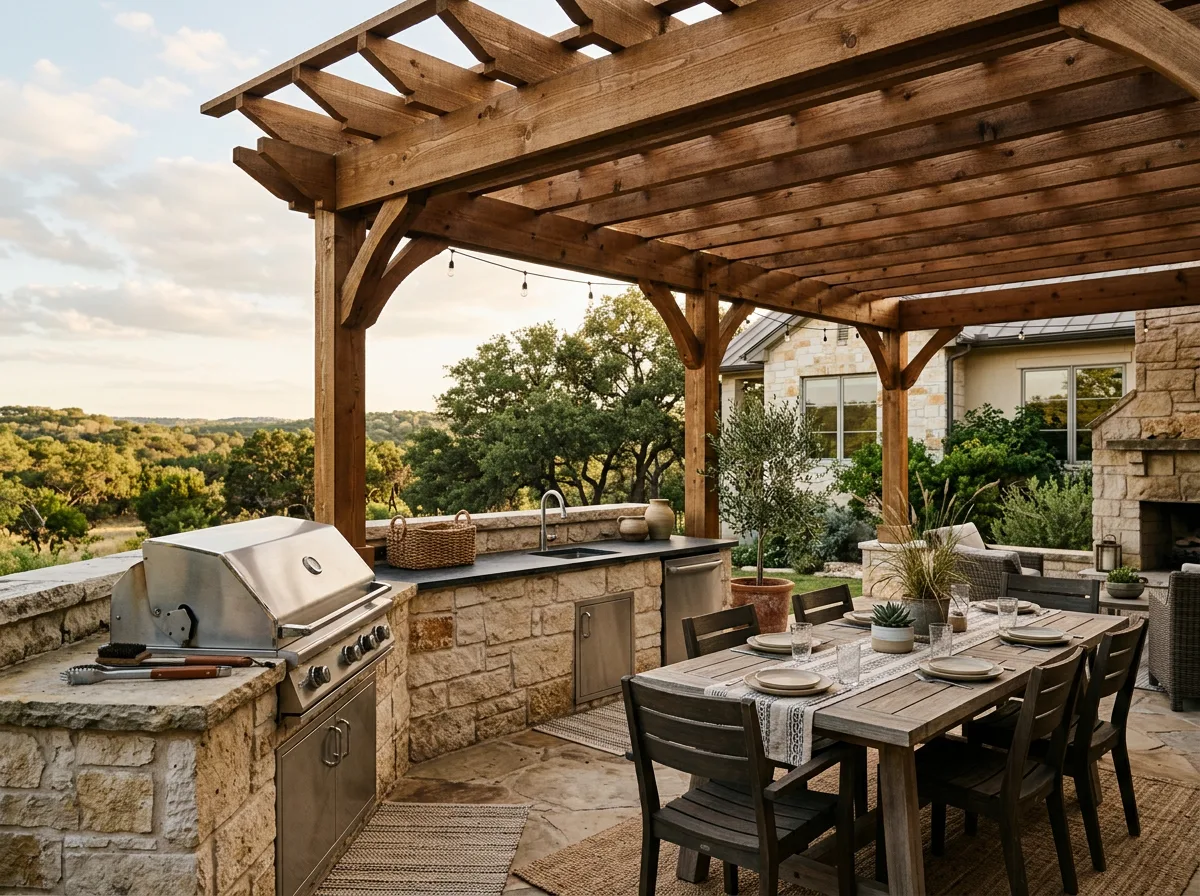
Our patios and pergolas work starts with sun direction, because an unshaded west-facing kitchen gets used in November and ignored in July. If you are still choosing between the two, read patio vs pergola first. Check the grill maker's clearance rules before placing a grill under any roof, and plan the cover with the kitchen so the posts, lights and gas line meet in the right places.
Is it cheaper to build an outdoor kitchen by the pool during the pool build?
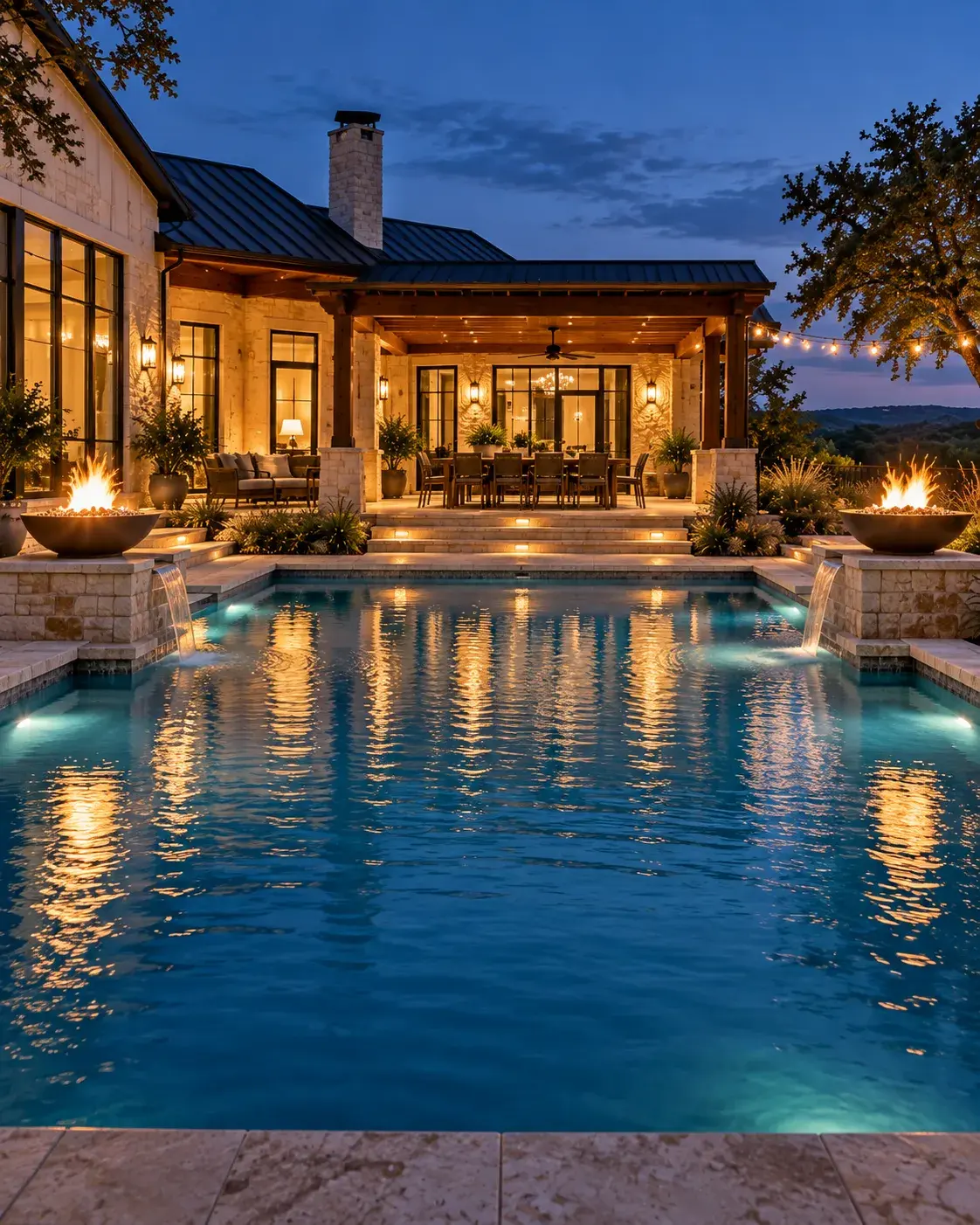
Usually, yes, because both jobs need gas, power, water and drain across the same yard. One open yard, one trench and one inspection cycle beat reopening finished decking later. We cannot promise a percentage, since savings depend on layout, rock and how much the kitchen shares with the pool equipment.
On our own builds, we plan the kitchen in the same 3D design as the pool, before contract, so utilities can be stubbed while the excavator is already on site. The shell, the deck and the island facade can then be ordered together, which lets us match the countertop to the pool tile and the facade to the coping. Our pool builds usually take 12 to 16 weeks after the permit, and we confirm how the kitchen fits that schedule during design. Our outdoor kitchens team handles both from one set of engineered drawings.
Timing matters here. The best time to build a pool in Austin is a start in fall or winter, which is why November is the planning window for spring 2027. If you want to be swimming and cooking by late spring, design, permit and HOA review need to start now. Financing terms vary by lender, so ask whether the kitchen can sit inside the same project loan, and read our pool financing page for how that works.
What should you do in November to be ready for a spring 2027 build?
Start with the yard and the rules, not the appliances. Walk the lot at 4 p.m. to see where the sun lands, find the gas meter and the panel, and read your HOA guidelines. Then pick a tier and ask for itemized bids.
- November: measure the yard, note the sun and the nearest utilities, and decide whether a pool is part of the plan.
- December: review a 3D design, choose appliances by model, and get bids with the seven cost lines itemized.
- January: submit permits and HOA packets, since review takes time and varies by city.
- Late winter: confirm appliance delivery, lock the schedule, and aim to build in the mild spring window.